23, Jalan Silc 2/3 Kawasan Perindustrian SILC, 79200 Iskandar Puteri, Johor

+607 509 5995

Introduction to Power Factor Solution​

Home / Introduction to Power Factor Solution

Understanding Power Factor & Capacitor Bank

What is Power Factor?

Power Factor is an index used to measure the efficient use of electricity. This index is measured on a range of 0 – 1.0. A high power-factor level indicates efficient electricity usage — and vice versa. A low power factor means high wastage of energy supplied or used.

Understanding Power Factor Surcharge

Power Factor Diagram

The illustration below shows the relationship between Active Power (kW), Reactive Power (kVAR), and Apparent Power (kVA). Improving the power factor reduces the angle between kW and kVA — increasing efficiency.

Active Power (kW) Reactive Power (kVAR) Apparent Power (kVA)
Active Power (kW)
Real power that performs useful work such as lighting, heating, and motor operation.
Reactive Power (kVAR)
Power used to maintain magnetic fields in inductive equipment like motors and transformers.
Apparent Power (kVA)
The total power — combination of Active and Reactive Power — supplied by the source.

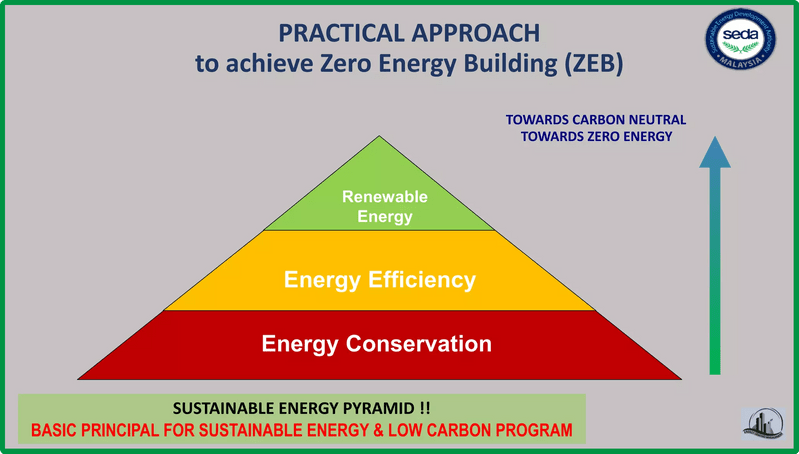
Energy Efficiency

Why Energy Efficiency is Important?

(National Energy Efficiency Action Plan (NEEAP) 2016–2025) – Promotes energy efficiency to ensure productive use of energy and minimize waste in order to contribute to sustainable development, increased welfare, and competitiveness.

(National Energy Policy (NEP) 2020–2040) – Aims to improve economic resilience and ensure energy recovery while achieving equality and universal access, as well as ensuring environmental sustainability.

Energy Efficiency
Energy Efficiency Concept

Energy Efficiency Definition

Energy efficiency can be defined as using the same or less amount of energy to produce a better output or using less energy to accomplish the same task — all while maintaining the same comfort level.

Technical Certification & Compliance Overview

Product CertificationProduct Certification

Product Certification & National Recognition

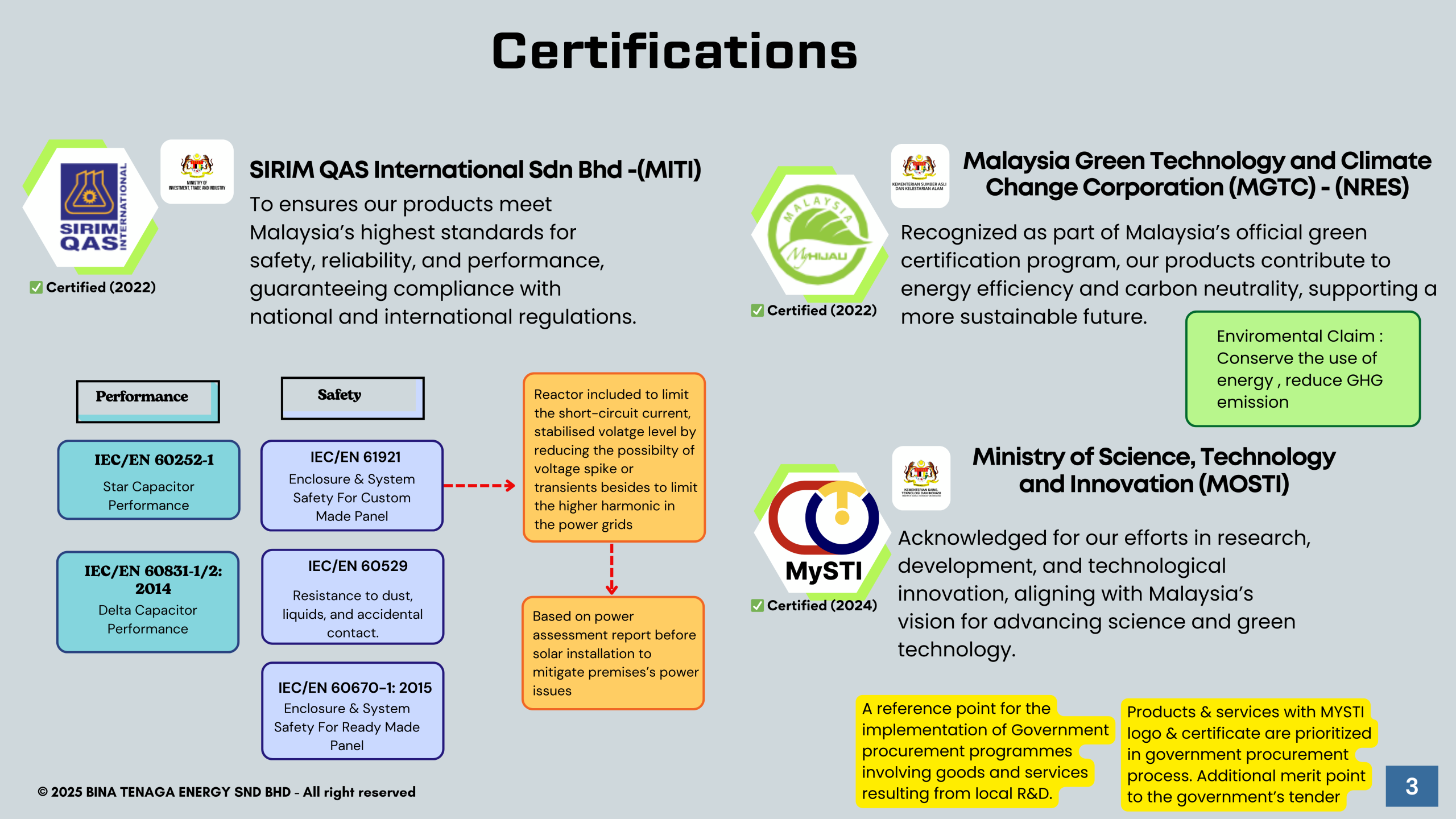
The PFCS-Binatenaga is a locally developed Smart Reactive Power Compensation System recognized for safety, innovation, and environmental excellence. It holds certifications that ensure compliance with Malaysia’s national standards and international IEC benchmarks.

  • MySTI Certified (MOSTI) – MY202400581, MY202400582, MY202400584.
  • SIRIM QAS International (MITI) – Safety & Performance Assurance.
  • MGTC GreenTech (NRES) – Energy Conservation & GHG Reduction.
  • IEC / EN Standards:
    • IEC 60252-1 – Star Capacitor Performance
    • IEC 60831-1/2 – Delta Capacitor Performance
    • IEC 61921 – System Safety (Custom Panel)
    • IEC 60529 – Ingress Protection Rating
    • IEC 60670-1 – Ready-Made Panel Safety
Power Quality Risk

Solution to Power Quality Risk

PFCS-Binatenaga tackles three major power-quality challenges in solar-integrated systems:

  • High Fault Level (HFL) – Star–delta compensation and line reactors limit short-circuit currents and stabilize voltage.
  • Voltage Swings – Automatic staged switching and reactor filtering smooth reactive power adjustments.
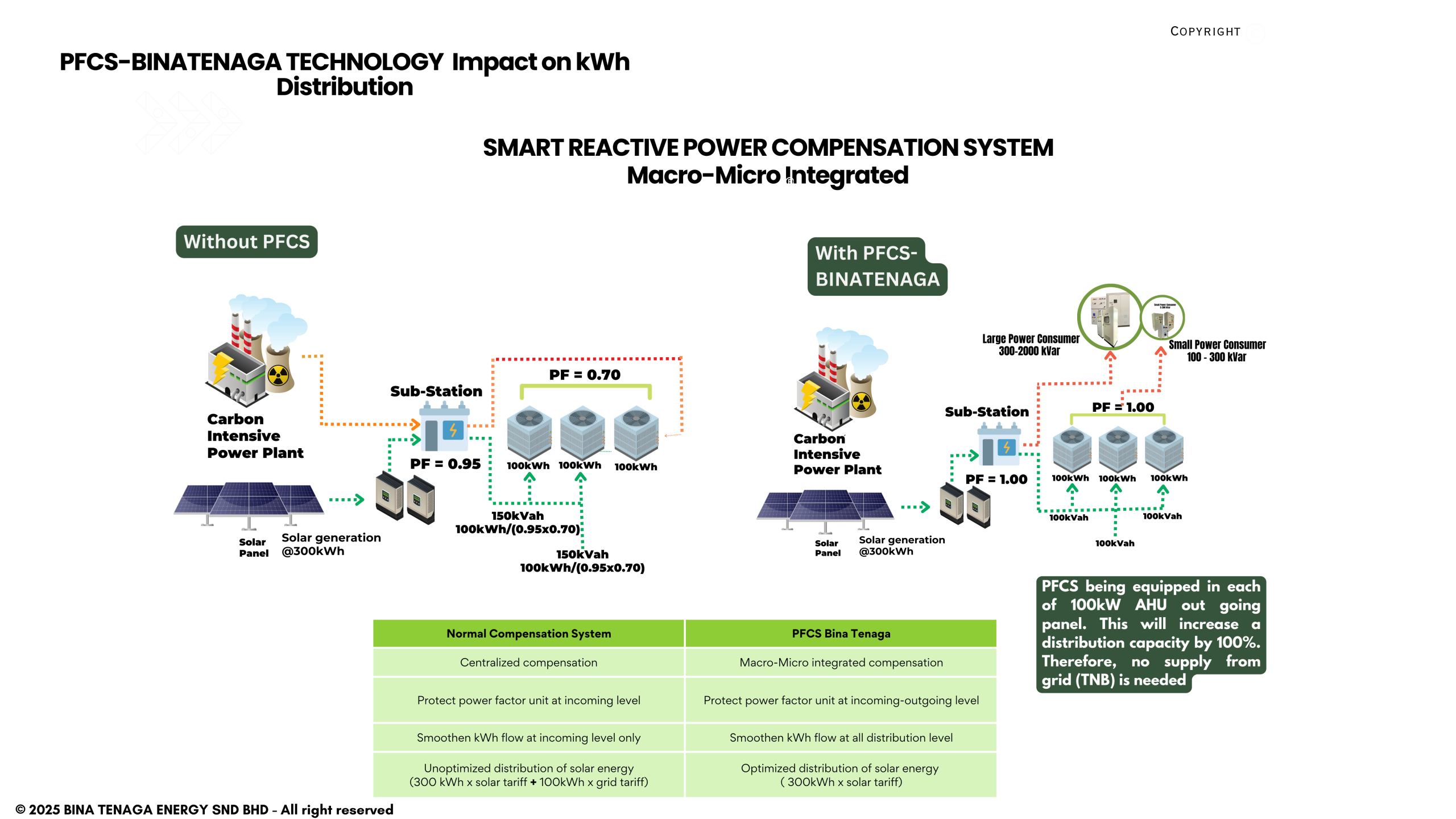
  • Power Factor Drop – Continuous monitoring maintains PF 0.96–1.00, eliminating TNB penalties.

Equipped with IoT Monitoring, Early Warning System (EWS) and self-healing mechanisms for real-time protection and stability.

Compliance Standards

Compliance with Power Quality & Standard

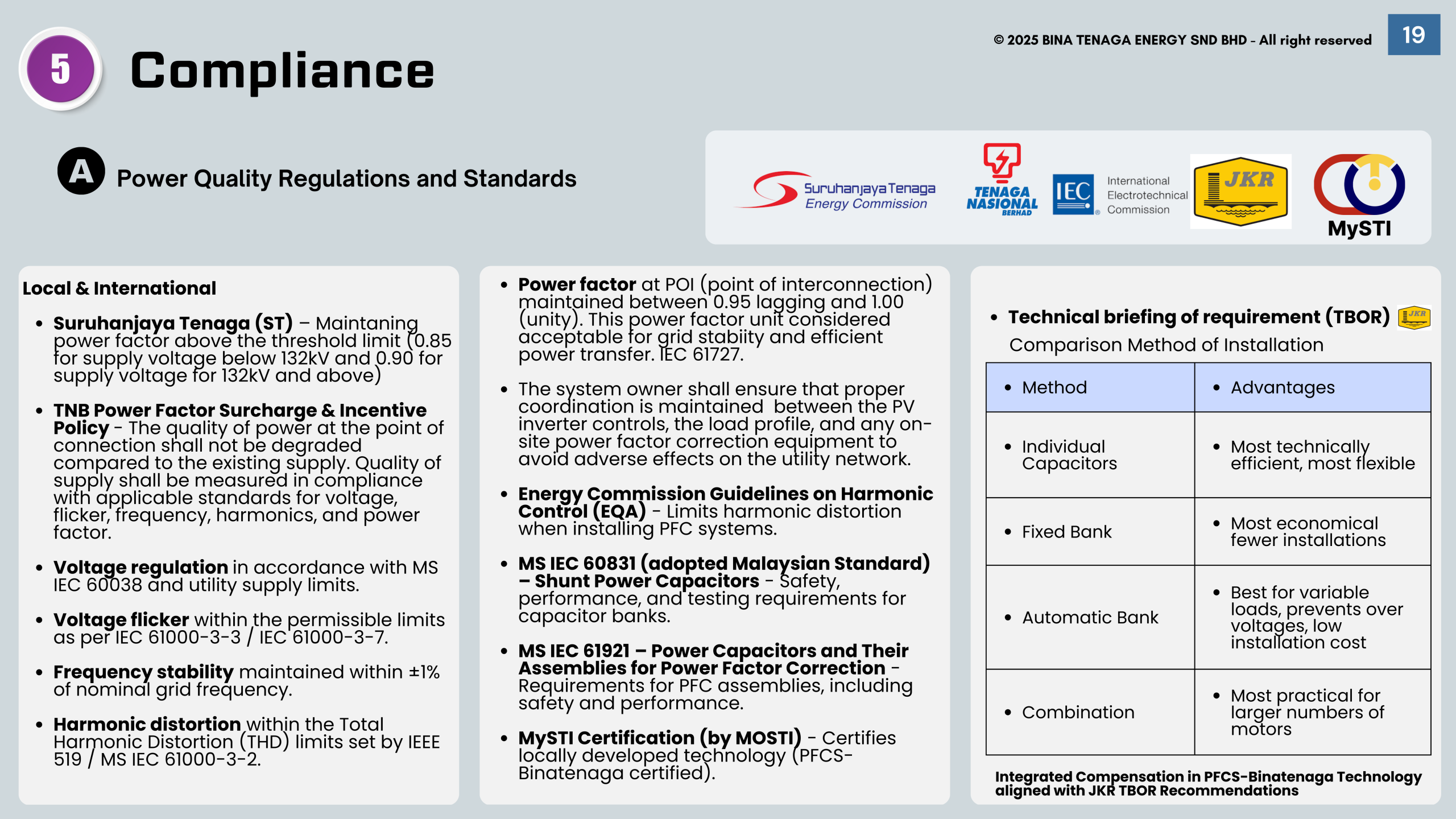
Designed to meet national and international requirements from Suruhanjaya Tenaga (ST), TNB and global bodies.

  • ST – PF ≥ 0.85 (below 132 kV) / ≥ 0.90 (132 kV and above)
  • TNB Policy – No degradation in voltage, flicker, harmonics or frequency
  • MS IEC 60038 – Voltage Regulation
  • IEC 61000-3-3 / 3-7 – Voltage Flicker Limits
  • IEEE 519 / MS IEC 61000-3-2 – Harmonic Distortion Thresholds
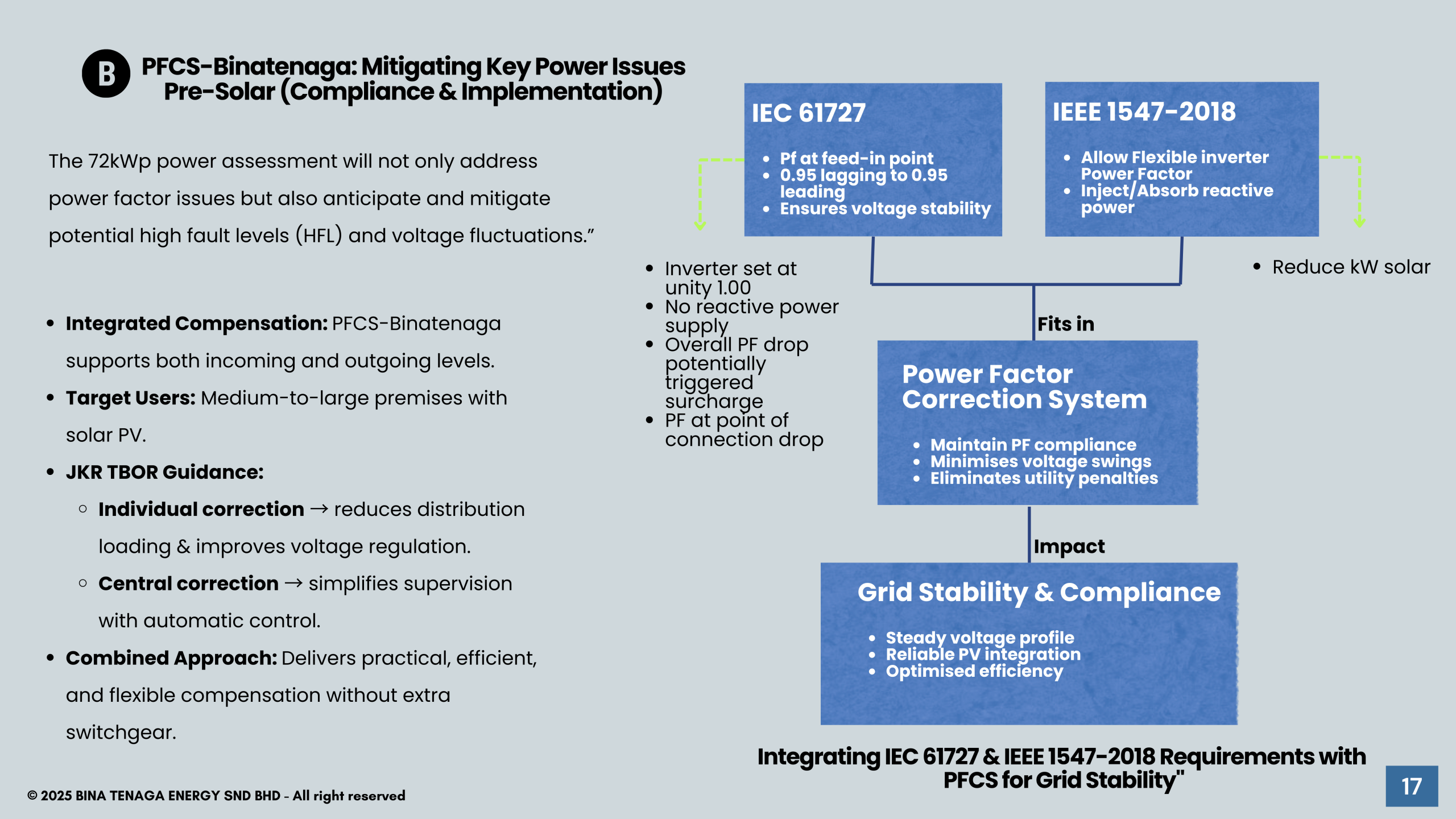
  • IEC 61727 – PV PF 0.95 lag to 1.00 unity
Technology Integration

Technology Integration

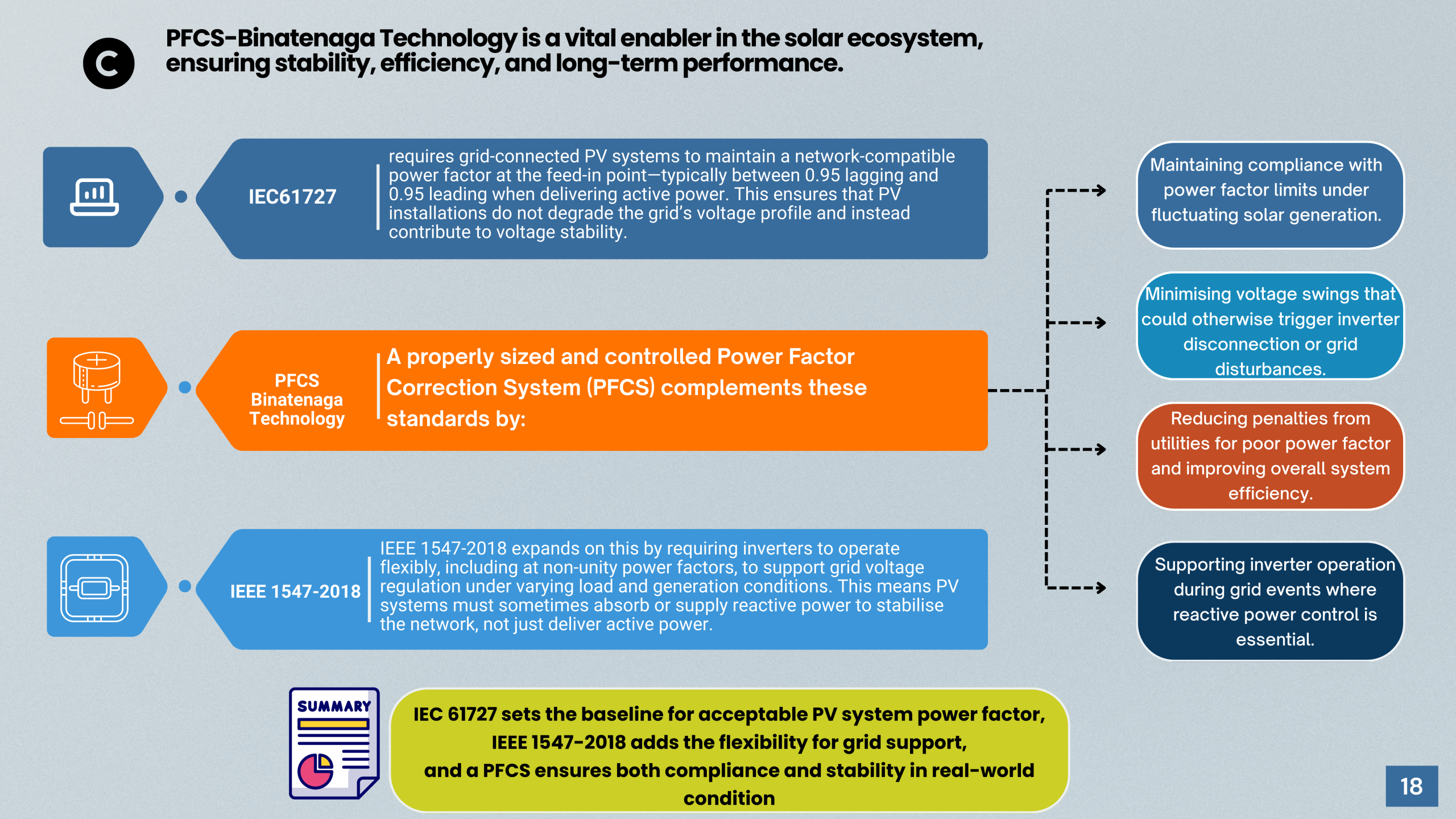
PFCS-Binatenaga integrates incoming and outgoing compensation for macro–micro control, maintaining grid stability and solar efficiency.

  • IEC 61727 – Defines PV system PF for voltage stability (0.95 lag–0.95 lead).
  • IEEE 1547-2018 – Inverter flexibility for reactive power support.
  • PFCS Function – Maintains PF compliance, reduces voltage swings, improves efficiency.
  • Aligned with JKR TBOR – Efficient installation and reliable control for medium-to-large premises.